Show Your Papers: The Unspoken Membership Rules of Vietnamese American Spaces
There's a particular kind of loneliness that hits when you're surrounded by people who are supposed to be your people—and you still feel like a guest.
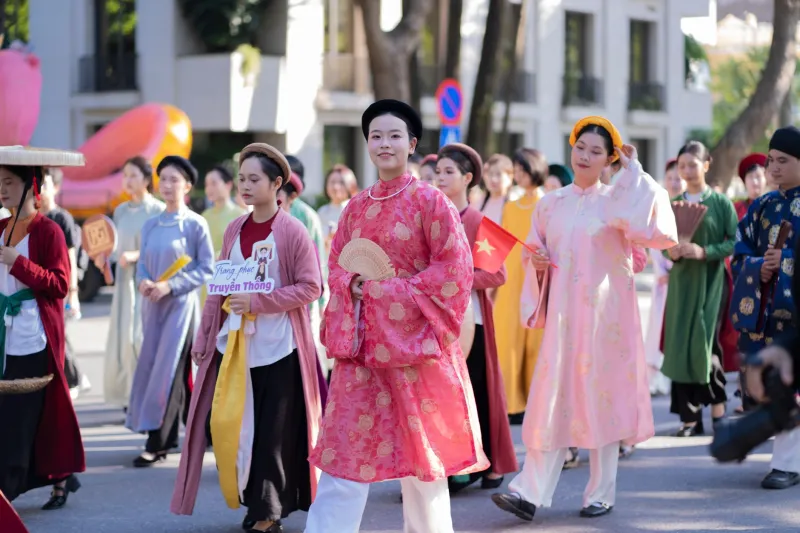
Maybe you walked into a Vietnamese church potluck in Garden Grove and someone asked where your family was from, then visibly cooled when you said the wrong province. Maybe you stumbled through a conversation at a Tết celebration and caught the look—that brief, polite smile that said your Vietnamese isn't quite right. Or maybe you've been to enough community events to notice that the same invisible rope always seems to be there, separating the ones who belong from the ones who are still auditioning.
The Vietnamese American diaspora is one of the most resilient, resourceful communities in the United States. It's also, if we're being honest with each other, one that can be quietly brutal about who counts.
The Language Checkpoint
Fluency is the first gate. If your tiếng Việt is shaky—if you reach for English mid-sentence, or your tones come out flat, or you mix in too much American slang—some people will clock it immediately. And for a lot of second-generation Vietnamese Americans, especially those raised in predominantly white suburbs or adopted into non-Vietnamese families, that checkpoint is where the welcome wagon stops.
Jennifer Ngô, 29, grew up in suburban Ohio with Vietnamese parents who pushed English at home to help her assimilate. She can understand conversations pretty well, but speaking is a struggle. "Every time I go to a Vietnamese event, I spend the whole time nervous about being asked a direct question," she says. "And when people find out I don't really speak it, I can feel the shift. Like I failed some test I didn't know I was taking."
Language carries enormous weight in the community—it's tied to history, sacrifice, identity. But using fluency as a proxy for authenticity leaves out a huge swath of people who are Vietnamese in every way that matters to them, just not in the way that's easiest to measure.
North vs. South, Old Money vs. New
Regional identity is another fault line that doesn't get talked about enough outside the community. The divide between northern and southern Vietnamese families—rooted in history, politics, and decades of mutual suspicion—didn't disappear when people landed in America. It just went underground.
In some circles, being from a southern family (or identifying with the Republic of Vietnam) carries a kind of cultural cachet among older diaspora members. In others, the regional hierarchies are flipped or complicated by newer waves of immigration. And for people who don't have a clean geographic origin story—mixed families, those who moved around Vietnam before leaving, refugees whose records were lost—even this identity marker can feel like contested ground.
Class runs parallel to all of it. The Vietnamese American community spans an enormous economic range, from families who arrived with professional credentials and rebuilt quickly, to those who spent years in refugee camps and started over with nothing. Those different starting points created different communities, different ZIP codes, different social circles. And while the official story is one of shared struggle, the reality is that class tensions show up in subtle, persistent ways—in who gets invited where, whose businesses get promoted, whose kids get the introductions.
The Mixed-Heritage Equation
For mixed-race Vietnamese Americans—those with one non-Vietnamese parent—the gatekeeping can be especially exhausting. You might look the part but not speak the language. Or speak the language but not look the part. Either way, you're often fielding some version of the same question: Are you actually Vietnamese?
The answer, of course, is yes. But in spaces where identity gets policed through appearance, language, or family name, "half" can feel like a permanent asterisk.
Marcus Lê, 34, whose father is Vietnamese and mother is Black, has navigated this his whole life. "In Black spaces, I'm the Vietnamese guy. In Vietnamese spaces, I'm the Black guy. I've basically accepted that I'm going to be the outsider everywhere," he says, laughing in a way that's only partly a joke. "But it does sting when it's your own community doing it. You'd think they'd get it—being othered. But sometimes the community that knows what it's like to be excluded is the most rigid about who gets to be included."
Newer Arrivals and the Authenticity Ladder
Then there are the more recent immigrants—Vietnamese nationals who came in the 2000s or 2010s for school, work, or family reunification. They're Vietnamese by every legal and cultural definition. But within diaspora spaces built by the refugee generation and their children, they can find themselves on the outside of a different door.
The culture gap is real. The political history is different. The references don't always overlap. And sometimes, frankly, the resentment flows both directions—older diaspora members who see newer arrivals as too aligned with a Vietnam they fled, newer arrivals who find the diaspora's relationship to the homeland nostalgic to the point of being frozen in amber.
Neither side is entirely wrong. But the result is a community that sometimes feels less like a single club and more like several clubs that share a name.
What the Door Should Actually Look Like
None of this is unique to Vietnamese Americans. Every diaspora community wrestles with authenticity politics, generational fractures, and the question of who gets to define the group. But it's worth naming it specifically here, in this space, because the cost of this gatekeeping is real.
When someone shows up to a Vietnamese American event and leaves feeling more alienated than when they arrived, the community loses them. When mixed-heritage kids decide the Vietnamese part of their identity isn't worth the hassle, the community loses something it can't get back. When newer immigrants feel unwelcome in diaspora spaces, and second-gen kids feel judged by newer immigrants, everyone ends up more isolated.
The Sài Gòn Social Club—this one, the idea of it—is supposed to be a place where the Vietnamese diaspora gathers. All of it. The fluent and the fumbling. The 1.5 generation and the 2.5. The northerners and the southerners. The ones who can make phở from memory and the ones who order it from an app and feel vaguely guilty about it.
Belonging to this community shouldn't require a credential. It should require showing up.
The question worth sitting with isn't are you Vietnamese enough—it's whether the spaces we build are wide enough to hold everyone who's trying to answer that question for themselves.