Two Families, One Banquet Hall, Zero Chill: Surviving the Viet-American Wedding Planning Process
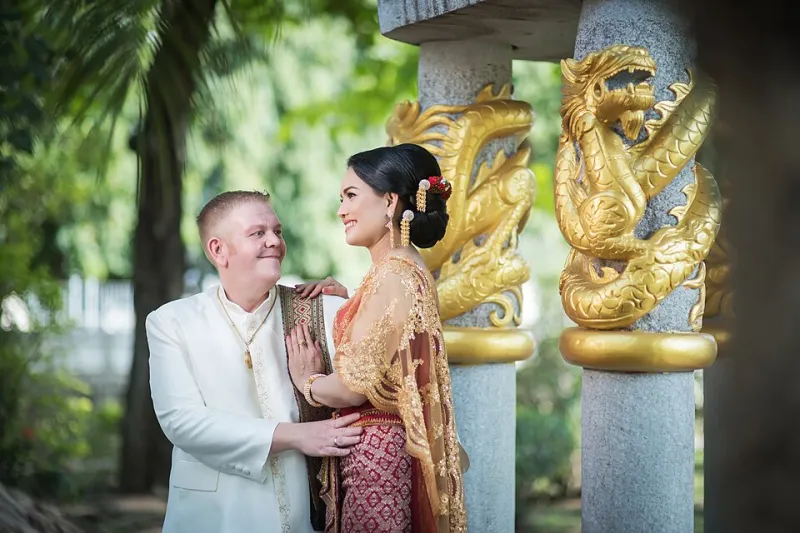
Photo: Skill74, CC BY-SA 4.0, via Wikimedia Commons
Let's set the scene. You're engaged. You're in love. You've already started a joint Pinterest board. And then — usually around the third or fourth family dinner after the announcement — the negotiations begin.
Your parents want a traditional Vietnamese lễ ăn hỏi (engagement ceremony) with the full tray procession. Your partner's family is wondering why the rehearsal dinner needs to be a separate event from the rehearsal dinner they already planned. You have strong opinions about a first dance song. Your future mother-in-law has stronger opinions about table centerpieces. And somewhere in the middle of all of this, you're supposed to be celebrating.
Welcome to the Vietnamese-American wedding planning experience. It's a lot. It's also, when it works, one of the most beautiful things you'll ever pull off.
The Real Tension Nobody Talks About Enough
The challenge of the Viet-American wedding isn't just logistical. It's emotional, and it runs deep.
For Vietnamese immigrant parents — many of whom arrived in the US with very little and built their lives from scratch — a child's wedding is more than a party. It's a public declaration of family honor, a performance of what they've achieved, and a connection to traditions that survived displacement and loss. The number of tables, the quality of the food, the formality of the ceremony: these things carry weight that their American-born children sometimes struggle to fully appreciate.
At the same time, second-generation Vietnamese-Americans have grown up surrounded by a very different wedding culture — one that emphasizes personal expression, intimate guest lists, and experiences that feel authentic to the couple rather than the community.
"Neither side is wrong," says Michelle Lê, a wedding planner in the San Jose area who specializes in multicultural ceremonies and has coordinated more than 60 Vietnamese-American weddings over the past decade. "They're just operating from completely different frameworks for what a wedding is supposed to accomplish. My job is basically to translate."
The Non-Negotiables (And How to Find Them)
Michelle's first piece of advice to every couple she works with is deceptively simple: figure out what's actually non-negotiable for each family member before you start making any decisions.
"Most people go into these conversations assuming everything is a battle," she says. "But when you actually sit down and ask your parents what they truly cannot let go of, the list is usually shorter than you expected. The key is asking the right way — not 'what do you want?' but 'what would you regret not having?'"
For many Vietnamese parents, the answer comes back to a handful of core elements: some form of the traditional ceremony (even abbreviated), the presence of an altar and ancestral acknowledgment, a formal tea ceremony, and — almost universally — enough food to feed everyone twice.
For the couples themselves, priorities tend to cluster around guest list control, ceremony personalization, and the reception vibe. A lot of Viet-American couples in their late 20s and 30s are specifically trying to avoid the four-hour, 300-person banquet experience they grew up attending. They want something smaller, more curated, more them.
The good news: these priorities don't have to conflict as much as they initially seem.
Creative Compromises That Have Actually Worked
The Two-Event Solution A growing number of couples are splitting the celebration entirely: a traditional Vietnamese ceremony (lễ ăn hỏi and/or lễ cưới) handled largely according to parental specifications, followed by a separate, more modern reception that reflects the couple's vision. Yes, it's more work. Yes, it costs more. But it removes the tension of trying to make one event serve two completely different purposes.
Anna and David Phạm, married in 2022 in Orange County, went this route. "We gave my parents full creative control over the morning ceremony," Anna explains. "Full traditional procession, full áo dài, the whole thing. Then that evening we had our reception at a restaurant we actually loved, with a DJ playing music we actually listen to. Everyone left happy."
The Hybrid Ceremony Insert For couples who want a single event, many planners now recommend building traditional Vietnamese ritual moments into an otherwise Western-style ceremony structure. A tea ceremony segment after the vows, an altar acknowledgment at the start of the reception, or a blessing from the eldest family members can satisfy the cultural requirements without restructuring the entire event.
"It's about giving the traditions their proper weight and time," Michelle says. "A tea ceremony that's rushed and shoved into a corner feels disrespectful. One that's given its own moment, properly lit, properly announced — that feels like an honor."
The Guest List Math This one's thorny, but there's a framework that helps. Some couples have found success by allocating a set number of invitations to each set of parents to distribute as they see fit, completely separately from the couple's own list. Parents get to invite their community; the couple gets their people. The numbers still have to work within the venue capacity, but it removes the negotiation of individual names from the couple's plate.
When It Gets Hard
Not every compromise lands cleanly, and it's worth being honest about that.
There are real moments of grief in the Viet-American wedding planning process — for parents who feel their traditions are being minimized, and for couples who feel their autonomy is being overridden. Therapy (yes, actual couples therapy, specifically around wedding planning) is more common than people admit, and several planners we spoke to quietly recommend it.
"This process surfaces every unresolved conversation a family has ever not had," says one planner who asked not to be named. "About assimilation, about sacrifice, about what it means to be Vietnamese in America. The wedding is just the occasion. The stuff underneath has been there for years."
That framing, while a little heavy for a party planning conversation, is actually kind of useful. When the argument is really about belonging and identity and love, knowing that can help you have a different — and more productive — version of it.
The Part Worth Holding Onto
For all the stress, the couples who come out the other side of a Viet-American wedding almost universally say the same thing: it was worth it.
Not just the wedding itself, but the process. The negotiations that forced real conversations. The moments when a grandparent's eyes lit up at a familiar ritual. The photos where you're wearing your áo dài next to your partner in their suit and the whole thing looks like exactly what it is — two worlds, one family, figuring it out together.
That's kind of the whole point of this community, isn't it? Figuring it out together.
Planning a Viet-American wedding and have a story to share? Drop us a note at the Sài Gòn Social Club — we're always looking for real voices from the community.