Pho Wars: Why Every Vietnamese Family Thinks Their Recipe Is the Only Right One
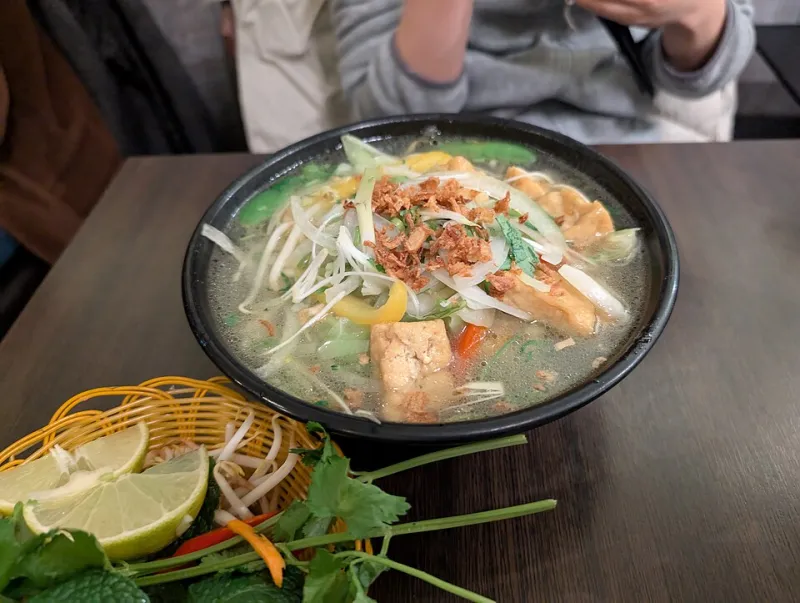
Photo: Andy Li, CC0, via Wikimedia Commons
Let me tell you about the single most dangerous question you can ask at a Vietnamese family gathering in America.
It's not politics. It's not asking about someone's salary (though that's a close second). It's this: "Do you put hoisin sauce in your pho?"
Watch what happens. Someone across the table will put down their chopsticks. An uncle will clear his throat. A grandmother will sigh in a way that communicates about forty years of personal history. And suddenly you're not just talking about soup. You're talking about where people are from, when they left, what they had to leave behind, and what they've been holding onto ever since.
Food in the Vietnamese diaspora is never just food. It's a whole argument about identity.
The Broth Situation
Okay, so here's where things get genuinely contentious. Northern-style pho — Hà Nội pho — is clean. The broth is clear, lightly seasoned, almost austere. A purist's bowl. You get your noodles, your beef, your broth, and maybe a few herbs. That's it. The flavors do the work.
Southern-style pho — the kind that came out of Sài Gòn and, eventually, out of the Vietnamese restaurants that spread across California and Texas and Virginia in the 1980s — is a completely different animal. Sweeter. Richer. More complex spicing. A full plate of bean sprouts, fresh basil, sliced chilies, lime wedges. And yes, little bottles of hoisin and sriracha on the table.
To a Northern Vietnamese person, adding hoisin to pho is basically a crime against culture. To a Southern Vietnamese person, being told you can't add hoisin is the crime.
Both sides are absolutely certain they are correct.
Here's the thing: they both are. That's the part nobody wants to admit.
Generational Receipts
The food debate gets even more layered when you factor in the generational split between immigrants and their American-born kids.
First-generation Vietnamese Americans often have an almost devotional relationship with certain dishes. The recipe is the memory. The specific way a broth tastes — the ratio of star anise to cinnamon, the particular fishiness of a nước chấm — is tied directly to a grandmother's kitchen in a city that may not even look the same anymore. Changing the recipe feels like losing something irreplaceable.
Their kids, though? Many of them grew up eating pho from the spot two miles away, or bánh mì from a food truck at a farmer's market that puts avocado in it. They've absorbed Vietnamese food through an American filter, and they're fine with that. More than fine — they'll defend that avocado bánh mì to their last breath.
This creates some genuinely hilarious dinner table dynamics. A second-generation Vietnamese American in her twenties told me her mom once watched her put sriracha on her cơm tấm and didn't speak to her for the rest of the meal. "Not dramatically," she clarified. "Just quietly. Which was somehow worse."
The Bánh Mì Spectrum
If pho is the main battlefield, bánh mì is the skirmish everyone's also fighting simultaneously.
The "classic" bánh mì — pâté, chả lụa, pickled daikon and carrots, cilantro, jalapeño, mayo — is already a hybrid creation. The baguette is French colonial. The combination of ingredients is Vietnamese ingenuity. It was never "pure" to begin with, and yet somehow people still argue about what does and doesn't belong on it.
Walk into any Vietnamese bakery in Garden Grove or Houston and you'll find a dozen variations. Grilled pork. Tofu. Fried egg. Sardines, if you're feeling adventurous. Each one has its loyalists. Each one has its detractors. And somewhere in the back of a Vietnamese grocery store in Milpitas, an 80-year-old woman is making a version that would make all of them irrelevant if you could just find it.
The food writer and daughter of Vietnamese refugees Andrea Nguyễn once described Vietnamese cuisine as "a living language" — something that changes depending on who's speaking it and where. That framing stuck with me. Languages have dialects. They evolve. They absorb new words. And people still argue about grammar.
Coffee: The Final Frontier
We cannot have this conversation without talking about cà phê.
Vietnamese iced coffee — the dark roast dripped slowly through a phin filter over sweetened condensed milk — is one of the great pleasures of the universe. This is not up for debate. What IS up for debate: how strong, how sweet, how much ice, and whether the addition of coconut milk makes it better or an abomination.
The Vietnamese coffee shop scene in the US has exploded in the last decade. Places like Nguyen Coffee Supply in New York or the dozens of independent Vietnamese cafés in Little Saigon neighborhoods have introduced a new generation to single-origin Vietnamese beans and specialty brewing methods. It's elevated. It's exciting. It's also prompted a subset of older Vietnamese Americans to wonder why anyone would spend $7 on something they can make at home for forty cents.
Both perspectives are valid. This is the diaspora experience in miniature: new iterations of old things, and the ongoing negotiation between preservation and evolution.
Why the Fight Is the Point
Here's what I've come to believe after years of watching Vietnamese Americans argue about food: the disagreement itself is the culture.
A monolithic community doesn't argue like this. A community that has collectively processed trauma, displacement, and reinvention across multiple generations and multiple geographies is going to have fractures. It's going to have regional loyalties and generational fault lines and individual family recipes that someone's grandmother swore on her life were the only correct version.
The fact that we're still arguing about pho broth — passionately, specifically, with genuine stakes — means we're still engaged. We still care. The food still matters enough to fight about.
And when you sit down at a table where someone's made something from scratch, where the broth has been simmering since morning and the herbs are fresh and someone's already put the hoisin sauce on the table even though half the room thinks that's wrong — you're not just eating dinner. You're participating in something ongoing. A conversation that started in kitchens in Hà Nội and Sài Gòn and hasn't stopped, even after it crossed an ocean.
So go ahead. Add the hoisin. Or don't.
Just be ready to defend yourself.